
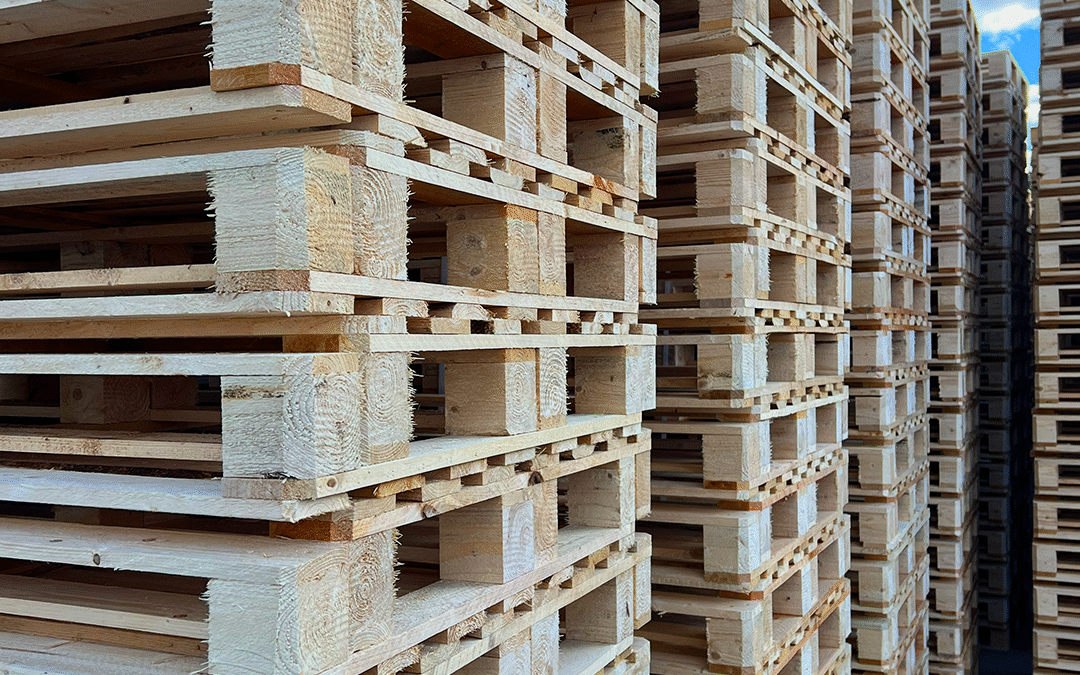
Wooden pallets are one of the most important logistics elements in both the manufacturing and retail sectors. While many people tend to choose standard Euro pallets, for companies with non-standard dimensions, higher value, fragile or specific shaped products, the best solution is often custom-made pallets. The right design can significantly reduce the risk of damage, optimize transportation costs and increase overall supply chain efficiency.
Standard Euro pallets (1200×800 mm) or industrial pallets (1200×1000 mm) are usually suitable for universal cargo, but their dimensions, design and permissible load do not always meet the requirements of individually manufactured products. The most common problem occurs when the product is too short, too narrow, too long or differs significantly in weight and packaging geometry. In such cases, unstable cargo is encountered, poorer storage, the need for additional intermediate materials and higher transportation risks. By choosing custom-made pallets, all these risks can be eliminated already at the design stage.
One of the most significant advantages of custom-made pallets is their precise adaptation to the product. This means that the pallet is designed taking into account the dimensions, weight, storage and loading method, packaging type and planned transportation routes of the product. This creates a solution that allows the product to be arranged in an optimal way, saves space in the warehouse and in the vehicle, and most importantly, ensures safety without additional packaging materials or expensive protective structures.
Another important factor is load capacity management. Custom-made pallets can be reinforced with thicker planks or more massive beams, and can also be designed with certain additional support points or double floor structures. This is especially relevant for companies working with metal structures, liquid containers, glass products or high-density materials. Such an investment pays off in reduced damage and a longer service life of the pallets.
When it comes to pricing, the cost of custom pallets depends on the type of wood, the complexity of the design, the dimensions and the quantity. Although such pallets may cost more than standard ones, the final cost in the logistics process is often lower due to reduced scrap, more efficient loading and less need for additional packaging materials. If a company plans to export outside the European Union, it is important to choose heat-treated (HT) pallets that meet the ISPM-15 standard with the IPPC mark, as this ensures compliance with international phytosanitary requirements.
The most common mistake when choosing wooden pallets is to base the decision solely on price and standard dimensions, without considering the real safety of the product and long-term logistics costs. There are also situations where the design is too weak, the loading method is not taken into account, the number of storage floors is not estimated, or too much free space is left between the product and the edge of the pallet. All these factors are invisible to the customer, but they become extremely significant during logistics and warehousing.
In conclusion, custom-made pallets are a rational choice for companies whose products vary in shape, weight or value criteria, especially if regular distribution or export is planned. It is a solution that allows for greater security, reduced risk of damage and better logistics control, and a properly designed pallet becomes not an expense, but an investment in a more efficient supply process.

Our goal is to provide a reliable, fast, and high-quality solution for every client, whether they need a single pallet or a large production batch of several hundred units.